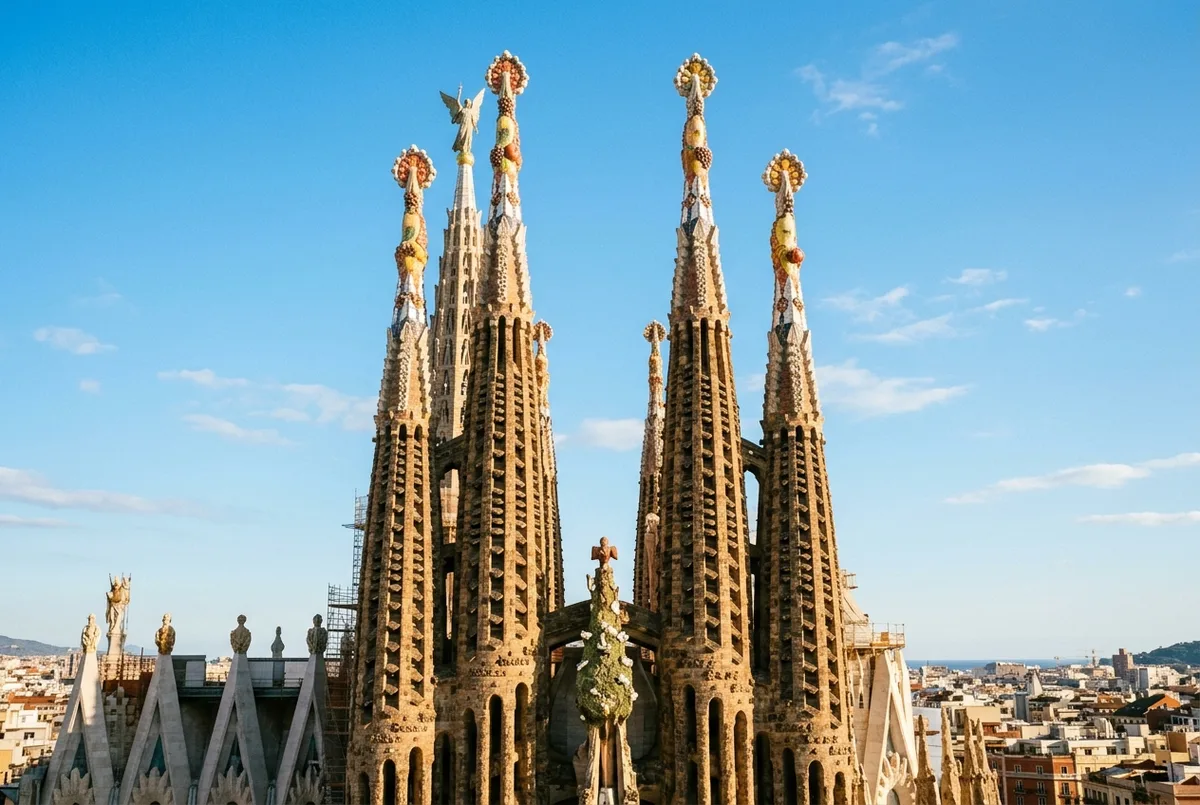
Each of the eighteen planned spires stands for a specific figure. Sagrada familia tower meanings run from twelve Apostle towers across the three facades, to four Evangelist towers, one for the Virgin Mary, and the tallest at the center for Jesus Christ.
Sagrada familia tower meanings go far deeper than architecture alone, since Antoni Gaudi designed every one of the basilica’s eighteen planned spires to represent a specific figure in the Christian faith. Understanding what each tower stands for turns a photo opportunity into a much richer visit, whether or not you plan to climb one yourself.
How Many Towers Does the Sagrada Familia Have?
The completed design calls for eighteen spires in total, though only some are finished today. Twelve represent the Apostles, spread across the basilica’s three facades, four represent the Evangelists, one represents the Virgin Mary, and the tallest, still under construction, represents Jesus Christ at the very center of the building.
Not every spire has been built yet, since construction has continued in phases for well over a century. The Apostle towers on the Nativity and Passion facades were completed earliest, while the central towers for Christ and the Evangelists have been finished more recently or remain in progress.
What Do the Apostle Towers Represent?
Each of the twelve Apostle towers is dedicated to one of Jesus’s twelve apostles, with four towers rising from each of the basilica’s three facades: Nativity, Passion, and the still-unfinished Glory facade. These are the towers that visitors actually climb on a tower-access ticket, since they house the elevators and staircases open to the public.
Gaudi topped each Apostle tower with distinctive finials shaped like fruit and wheat, symbols of abundance and the Eucharist, along with a bishop’s mitre near the top referencing each apostle’s role as a foundation of the early church. Our nativity vs passion tower comparison covers what it is actually like to climb one of these towers today.
What Do the Evangelist Towers Represent?
Four separate towers, taller than the Apostle towers, represent the four Evangelists who wrote the Gospels: Matthew, Mark, Luke and John. Each one is topped with the traditional symbol associated with that Evangelist in Christian art: a winged man for Matthew, a winged lion for Mark, a winged ox for Luke, and an eagle for John.
These towers surround the central spire rather than rising from the outer facades, positioning the Evangelists close to Christ at the heart of the building’s design, both physically and symbolically.
What Does the Tower of the Virgin Mary Represent?
A single tower, positioned near the Nativity facade, is dedicated to the Virgin Mary and topped with a twelve-pointed star, a reference to the crown of stars described in the Book of Revelation. This tower rises higher than the Apostle towers but sits below the height of the Evangelist towers and the central Christ tower, reflecting Mary’s position in Catholic theology as exalted above the Apostles yet below Christ himself.
At night, the star on top of the Mary tower is illuminated, making it visible across large parts of Barcelona and giving the basilica a distinctive silhouette after dark.
What Does the Tower of Jesus Christ Represent?
The central and tallest spire, still being completed, represents Jesus Christ and is designed to reach roughly 172.5 meters, a height Gaudi specifically chose to fall just short of Montjuic, the hill overlooking Barcelona. Gaudi reportedly felt that his creation should never surpass God’s creation, so the tower’s final height was set deliberately below the hill’s elevation rather than aiming for a record-breaking structure.
Once finished, this tower will make the Sagrada Familia the tallest church building in the world, topped with a large illuminated cross visible from across the city.
Why Do the Towers Have Fruit Shaped Decorations Near the Top?
The colorful, globe-like finials near the top of several towers represent fruit and harvest, symbols Gaudi used throughout the design to connect the building’s religious themes to the natural world he drew so much inspiration from. Bunches of grapes, wheat sheaves and other harvest imagery appear alongside more traditional Christian symbols, reflecting Gaudi’s belief that nature itself was a form of divine design.
This blending of natural and religious symbolism runs through the entire basilica, not just the towers, and it is part of what makes the Sagrada Familia distinct from more traditional European cathedrals.
Why Are Some Towers Still Unfinished?
Construction has continued in phases since 1882, funded entirely by private donations and ticket revenue rather than government money, which has always shaped how quickly work can proceed. The Glory facade and its four Apostle towers remain among the last major sections still under construction, alongside finishing touches on the central Christ tower.
Modern construction techniques and computer modeling have accelerated recent progress considerably compared to the pace Gaudi worked at using hand-drawn plans and physical models, though a firm completion date has shifted more than once over the decades.
Does Understanding the Symbolism Change How You Experience a Visit?
Many visitors say it does, since recognizing the fruit finials, the Evangelist symbols or the star on Mary’s tower turns what could be a quick photo stop into a much richer few minutes of looking closely at details that are easy to miss otherwise. Our Antoni Gaudi architect guide goes further into the design philosophy behind these choices, useful reading if the symbolism here has you curious about the man who conceived it.
Which Towers Can You Actually Visit?
Only the Apostle towers on the Nativity and Passion facades are open to the public with a tower-access ticket, since the Evangelist, Mary and central Christ towers are either structurally unsuited to visitor access or still under construction. If the symbolism described here has you leaning toward booking the climb, our is the tower worth it guide covers the practical details, including stairs, height and views, before you commit.
Why Did Gaudi Choose Symbolism Over a More Conventional Design?
Gaudi believed a church building should teach its story to anyone who looked closely at it, even visitors who could not read scripture themselves. Rather than relying only on stained glass scenes or interior carvings the way older cathedrals often do, he built the theology directly into the exterior structure itself, so the towers, the facades and even small decorative details all carry meaning rather than existing purely for visual effect.
This approach is part of why architects and religious scholars alike still study the Sagrada Familia today. Few buildings anywhere combine this level of structural engineering with this density of intentional symbolism, and the towers are the clearest example of that combination since their height, order and decoration were all chosen to communicate a specific idea rather than simply to look impressive.
How Does the Tower Layout Reflect the Order of the Facades?
The Nativity facade, celebrating Christ’s birth, carries its four Apostle towers on the side of the building that faces sunrise, while the Passion facade, depicting Christ’s suffering and death, carries its four towers facing sunset. The Glory facade, representing eternal life and still under construction, will eventually carry the final four Apostle towers once complete.
This arrangement means the physical layout of the towers mirrors the narrative arc of the Christian story, from birth through death to eternal glory, moving across the building from one side to the other. Visitors who understand this layout often notice that the mood of each facade, from joyful to somber to eventually triumphant, lines up with the towers rising above it.
Ready to See the Towers in Person?
If you want to experience the Apostle towers described above firsthand, the tower access guided tour bundles the elevator climb with the full guided interior visit. For availability and booking lead time on tower tickets generally, see our sagrada familia tower tickets guide.
Whichever ticket format you choose, book your sagrada familia tickets online a little ahead of your travel dates, since popular time slots fill up faster than most first-time visitors expect. For verified details on the ongoing construction and current tower status, the official Sagrada Familia website is the most reliable source.
Frequently Asked Questions
How many towers will the Sagrada Familia have when finished?
Eighteen in total: twelve for the Apostles, four for the Evangelists, one for the Virgin Mary, and the tallest central tower for Jesus Christ.
Which tower is the tallest at the Sagrada Familia?
The central tower dedicated to Jesus Christ, designed to reach approximately 172.5 meters, making it the tallest of all eighteen planned spires.
What do the fruit shaped decorations on the towers mean?
They represent harvest and abundance, connecting the basilica’s Christian symbolism to the natural forms Gaudi drew inspiration from throughout the design.
Can visitors climb every tower at the Sagrada Familia?
No. Only the Apostle towers on the Nativity and Passion facades are open to visitors with a tower-access ticket. The Evangelist, Mary and Christ towers are not open to the public.
Why is the central tower not taller than Montjuic hill?
Gaudi reportedly designed the height deliberately to remain just below Montjuic, reflecting his view that his creation should never surpass what he considered God’s own creation.
Ready to visit?
Book your tickets in advance: popular time slots sell out.