Antoni Gaudi: The Architect Behind Sagrada Familia
Quick answer
Antoni Gaudi was the Catalan architect who took over as antoni gaudi sagrada familia architect in 1883 and spent the rest of his life reshaping the design around his own naturalist vision, a legacy that still guides construction today.
Antoni Gaudi sagrada familia architect is the name behind nearly everything visitors recognize about the basilica today, from the tree like columns to the fruit shaped spires. Gaudi did not just design a building, he reimagined an entire unfinished project and spent the final decades of his life devoted to it almost exclusively. Here is who he was and why his fingerprints are on every corner of the design.
Who Was Antoni Gaudi?
Antoni Gaudi i Cornet was a Catalan architect born in 1852, widely considered the leading figure of Catalan Modernism, a regional style closely related to Art Nouveau. Beyond Sagrada Familia, he designed several other Barcelona landmarks, including Park Guell and Casa Batllo, both known for the same organic, nature inspired forms he brought to the basilica.
Where Did Gaudi Study Architecture?
Gaudi trained at the Barcelona School of Architecture, graduating in 1878 after a program his professors reportedly found difficult to grade, given how far his ideas already diverged from conventional design principles at the time. The school’s director is said to have remarked that he had just given the diploma either to a madman or a genius, a comment that has followed Gaudi’s legacy ever since.
When Did Gaudi Take Over the Sagrada Familia Project?
Gaudi became the project’s chief architect in 1883, just a year after construction began under a different architect, Francisco de Paula del Villar. Villar had planned a fairly conventional Gothic revival church, but Gaudi reworked the design so extensively that almost nothing of the original plan remained by the time he was finished.
Why Did Gaudi Redesign the Building So Completely?
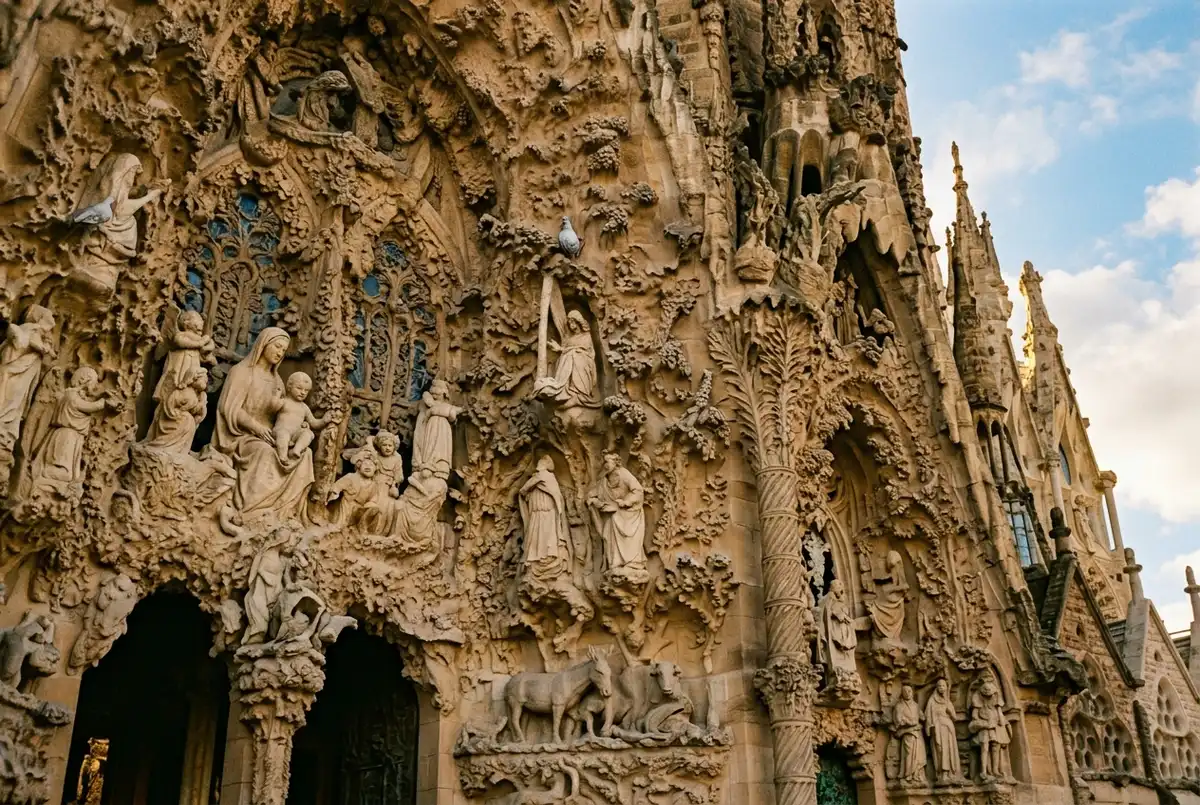
Gaudi believed architecture should draw directly from nature rather than repeat historical styles, so he replaced Villar’s Gothic revival plans with branching columns modeled on tree trunks, ceiling vaults shaped like natural forms, and facades built to tell the Christian story through carved detail rather than stained glass alone. This shift is why the basilica looks so different from the Gothic cathedrals most visitors expect.
What Made Gaudi’s Design Style So Unique?
Gaudi’s naturalist approach used hyperboloid and paraboloid shapes borrowed from plants, bones, and shells, structures he tested using hanging chain models rather than traditional blueprints. This method let him calculate complex load bearing curves decades before computer modeling existed, an engineering approach that architects still study today. Our what to expect inside guide shows how these shapes look once you are standing beneath them.
Did Gaudi Work on Sagrada Familia Full Time?
Not at first, but he eventually did. Gaudi juggled several commissions across Barcelona early in his career, but from around 1914 onward he turned down almost all other work and devoted himself entirely to the basilica, eventually moving into a small workshop on the construction site itself.
Is This the Famous Cathedral in Barcelona People Search For?
Yes, though technically it is a basilica rather than a cathedral. The famous cathedral in Barcelona Sagrada Familia confusion is extremely common, since most visitors use the words interchangeably. Barcelona’s actual cathedral, La Seu, is a separate, older Gothic building in the Gothic Quarter, distinct from Gaudi’s basilica.
How Did Gaudi Die?
Gaudi was struck by a tram in 1926 near the basilica and died a few days later at age 73. He was reportedly mistaken for a homeless man at first due to his simple, worn clothing, since he had stopped caring about his personal appearance in his final years and lived modestly despite his fame.
What Happened to Gaudi’s Plans After His Death?
Much of Gaudi’s original documentation was destroyed in a fire during the Spanish Civil War in 1936, when anarchist groups burned his crypt and workshop. Architects since then have relied on surviving plaster models, photographs, and fragments to reconstruct his intentions as closely as possible, a painstaking process that shaped how later sections of the building were completed.
Where Is Gaudi Buried?
Gaudi is buried in the crypt of the very building he devoted his life to, beneath the Sagrada Familia itself. The Catholic Church has formally opened a cause for his beatification, reflecting how closely his life’s work is tied to religious devotion rather than architecture alone.
Does Booking a Tour Teach You More About Gaudi?
Yes, generally. Standard entry tickets let you explore at your own pace, but a gaudi sagrada familia tickets guided option adds live context about his design choices, symbolism, and engineering methods that a self-guided visit can easily miss. Our guided tour vs audio guide comparison covers which ticket format goes deepest into his life and design philosophy.
Did Gaudi Design Anything Else Besides Sagrada Familia?
Yes, extensively. Beyond the basilica, Gaudi designed Casa Mila and Casa Batllo, two residential buildings in central Barcelona known for their flowing, almost sculptural facades, along with Park Guell, a public park built around his naturalist architectural ideas. All of these works, together with the Sagrada Familia’s Nativity facade and crypt, were jointly recognized on the UNESCO World Heritage List in 2005.
How Did Gaudi’s Personal Life Shape His Later Work?
Gaudi grew increasingly devout as he aged, and by the time he was working almost exclusively on Sagrada Familia he had adopted a famously ascetic, simple lifestyle, fasting frequently and living modestly despite decades of architectural fame. Many biographers connect this personal transformation directly to how thoroughly religious the basilica’s later design became, compared to his more decorative early residential work.
How Does Gaudi’s Work Connect to the Building’s Symbolism?
Gaudi treated the entire basilica as a physical retelling of the Christian story, using tower placement, facade orientation, and carved detail to communicate meaning rather than relying on stained glass narrative scenes alone. Eighteen planned spires, from the twelve Apostle towers to the central spire for Christ, each carry their own symbolic role in that story.
When Is the Basilica He Designed Expected to Be Finished?
Even decades after his death, construction timelines built around Gaudi’s designs keep shifting as funding and engineering complexity evolve. Our Sagrada Familia tower completion guide covers the current construction status and what remains unfinished from his original vision.
Can You Watch the Ongoing Construction of Gaudi’s Design?
Yes, to an extent. Our Sagrada Familia live webcam guide covers where to watch construction on Gaudi’s still unfinished design remotely, a small but genuine way to follow the project’s progress from anywhere.
Why Do Visitors Say Knowing Gaudi’s Story Changes the Visit?
Understanding that one architect rebuilt an entire unfinished project around his personal vision, then spent his final years living on site to see it through, reframes the basilica from an unusual landmark into a deeply personal, still unfolding statement. Our Sagrada Familia facts and history guide covers the fuller construction timeline around his life’s work.
What Should You Look for on Site to Recognize His Style?
Once you know what to look for, Gaudi’s fingerprints are everywhere: broken tile mosaics called trencadis, columns that lean and branch rather than stand perfectly straight, and organic shapes borrowed from bones, shells, and plants rather than classical geometry. Spotting these recurring motifs across the towers, facades, and interior columns turns a walk through the basilica into a kind of scavenger hunt for his signature techniques.
Is Learning About Gaudi Worth It Before You Visit?
For most travelers, yes. Our is Sagrada Familia worth it review weighs the architecture and history against cost and crowds, useful reading if Gaudi’s story has you leaning toward booking a visit.
Once his story has you ready to see the work in person, book your la sagrada familia ticket with a specific time slot ahead of your trip, since popular hours sell out first, particularly in peak season.
For verified biographical details and the latest on his beatification cause, the official Sagrada Familia website is the most reliable source to check.
Frequently Asked Questions
Who was the architect of the Sagrada Familia?
Antoni Gaudi, a Catalan architect, took over the design in 1883 and devoted much of his life to the project until his death in 1926.
Did Gaudi finish the Sagrada Familia before he died?
No. He completed less than a quarter of the building during his lifetime, though his plaster models and design principles continue to guide construction today.
Is the Sagrada Familia the same as Barcelona’s cathedral?
No. It is officially a basilica, while Barcelona’s actual cathedral, La Seu, is a separate Gothic building in the Gothic Quarter.
What other buildings did Gaudi design in Barcelona?
Gaudi designed several other Barcelona landmarks, including Park Guell and Casa Batllo, both featuring his signature naturalist style.
Where is Antoni Gaudi buried?
Gaudi is buried in the crypt beneath the Sagrada Familia, the building he devoted the final decades of his life to completing.
Ready to visit?
Book your tickets in advance: popular time slots sell out.